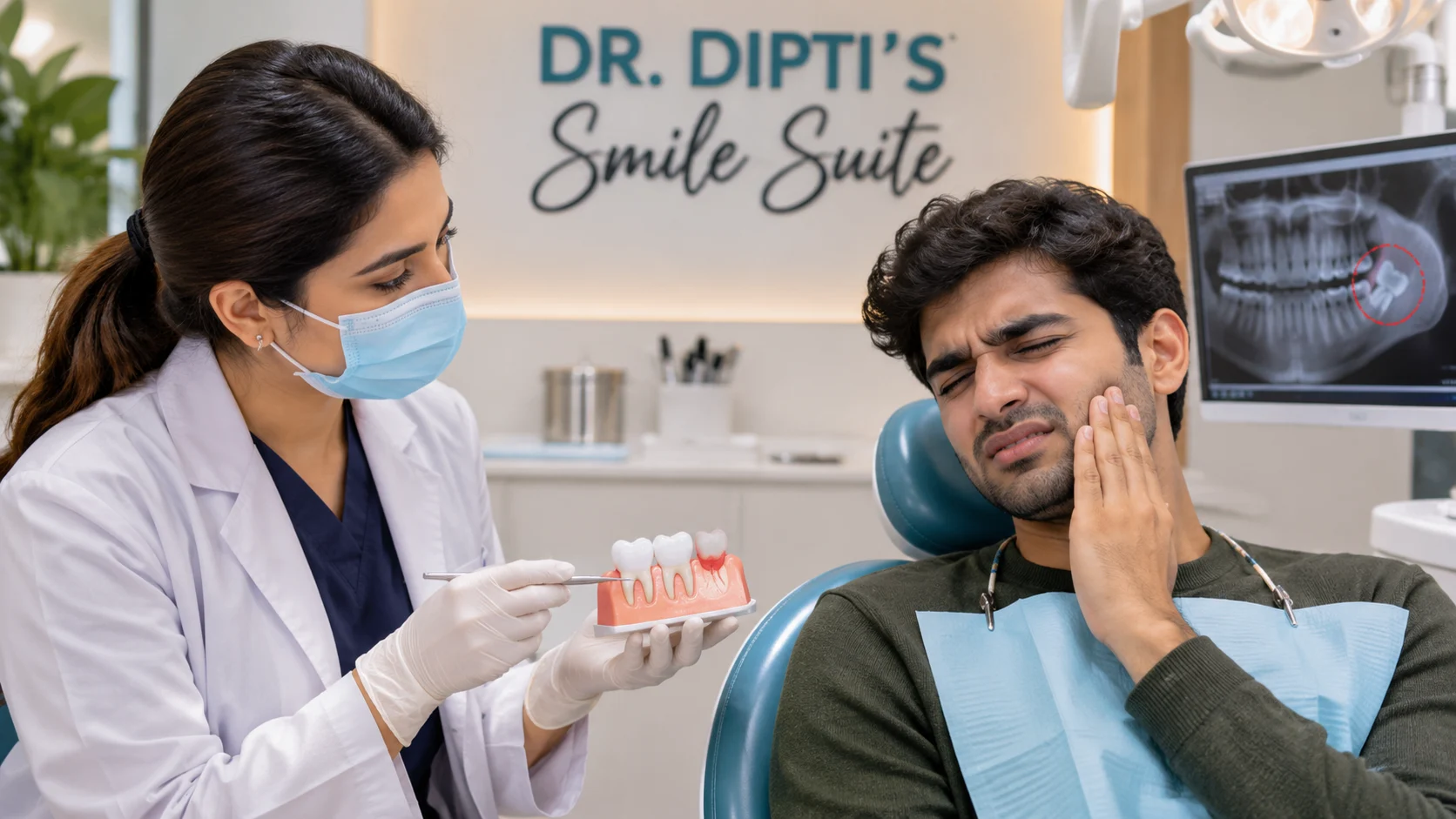
Wisdom tooth pain is one of the most common reasons young adults visit our clinic in Faridabad. It is also one of the most commonly ignored. Many people take a painkiller, wait for the pain to settle, and repeat that cycle for months or years.
This guide explains:
- Why wisdom teeth cause pain
- Which symptoms can be managed briefly at home
- The warning signs that mean you should see a dentist soon, or get emergency care
- What treatment actually involves, from cleaning a sore gum to removing the tooth
What Are Wisdom Teeth and Why Do They Cause Trouble?
Wisdom teeth are the third molars, the last teeth at the very back of each side of the upper and lower jaws. Most people have four, although some have fewer or none. They usually appear between the ages of 17 and 25, long after the other adult teeth.
By then, the jaw is often too small to fit them comfortably. A wisdom tooth that cannot come through fully, because it is blocked by bone, gum or the tooth in front of it, is called impacted. A 2016 meta-analysis in the Journal of Dental Research, covering 49 studies and more than 83,000 people, found that 24.4% of people worldwide have at least one impacted wisdom tooth. The same study found that lower wisdom teeth are much more likely to be impacted than upper ones.
A larger 2024 meta-analysis found an even higher pooled figure of 36.9% per person, with the highest rates in Asia.
Impacted wisdom teeth may sit:
- Tilted forward (mesioangular): leaning into the tooth in front; the most common type
- Upright (vertical): stuck below the gum or bone
- Tilted backward (distoangular): leaning towards the back of the jaw
- Lying sideways (horizontal): completely on their side under the gum
Some wisdom teeth come in straight, function normally and never cause problems. Others cause pain repeatedly. The difference usually lies in the angle, the space available, and how easy the area is to keep clean.
Common Causes of Wisdom Tooth Pain
Eruption pressure
As a wisdom tooth pushes through the gum, the area can feel sore and tender, much like teething in children. This pain often comes and goes over weeks or months.
Pericoronitis: infected gum around the tooth
When a wisdom tooth is only partly through the gum, a flap of gum covers part of it. Food and bacteria collect under this flap, and the gum becomes inflamed or infected. This is called pericoronitis. Symptoms include:
- Swollen, red, tender gum behind the last tooth
- Pain when biting, often because the upper tooth bites onto the swollen flap
- A bad taste or pus
- Bad breath
- Difficulty opening the mouth fully
- Pain when swallowing
- Swollen glands under the jaw, and sometimes fever
Pericoronitis is the most common reason wisdom teeth are removed. In a UK study of 1,011 patients having lower wisdom teeth removed, pericoronitis was the main reason in 49% of cases. Patients in that group were on average 27.5 years old.
Decay in the wisdom tooth
Wisdom teeth are hard to reach with a toothbrush, so they decay easily. Decay can cause sensitivity, then lingering or throbbing pain if it reaches the nerve.
Decay in the tooth in front (the second molar)
A tilted wisdom tooth can trap food against the back of the second molar, causing a cavity at the gumline that is hard to see and hard to clean. This hidden decay can damage a perfectly healthy second molar. In the same UK study, it was the reason for removal in 14% of cases. It is especially common with forward-tilted wisdom teeth.
Gum disease around the back teeth
Pockets that form around partly erupted wisdom teeth collect bacteria and can lead to gum and bone loss behind the second molar.
Cheek biting and ulcers
Upper wisdom teeth sometimes come in tilted towards the cheek. Their sharp edges rub or bite the cheek, causing sore spots and ulcers.
Cysts (uncommon)
Rarely, a fluid-filled sac (cyst) forms around an impacted wisdom tooth. Cysts may grow silently and weaken the jaw bone. They are usually found on X-rays before they cause pain.
Pain that is not from the wisdom tooth
Pain at the back of the jaw can also come from jaw joint (TMJ) problems, grinding, sinus infection or ear infection. A proper examination tells them apart.
Safe Relief While You Arrange a Dental Visit
These measures can ease mild wisdom tooth pain for a day or two. They do not treat infection or impaction.
- Warm salt water rinse: half a teaspoon of salt in a glass of warm water; swish gently around the back of the mouth after meals
- Gentle cleaning: brush carefully around the wisdom tooth with a soft or small-headed brush to remove trapped food
- Cold compress: hold a cold pack wrapped in cloth against the cheek, 15 minutes on and 15 minutes off
- Soft foods: eat soft food and chew on the other side
- Over-the-counter pain relief: take a suitable pharmacy pain reliever exactly as the label directs, after checking with a pharmacist if you have medical conditions, take other medicines, or are pregnant
- Keep your head raised at night to reduce throbbing
Avoid placing aspirin on the gum, applying heat to a swollen face, or taking leftover antibiotics.
Read more: Toothache at Night: Home Remedies Until You See a Dentist
When to See a Dentist for Wisdom Tooth Pain
Book a dental appointment within a few days if:
- The pain lasts longer than two or three days
- Pain keeps coming back every few weeks or months
- The gum behind your last tooth is swollen, red or tender
- You notice a bad taste, pus or bad breath that won’t go away
- Chewing on that side hurts
- Food keeps getting stuck behind your back teeth
- An upper wisdom tooth is biting your cheek
- You are planning braces, Invisalign, implants or a pregnancy, and haven’t had your wisdom teeth assessed
Even without pain, a check-up and X-ray in your late teens or early twenties helps predict whether your wisdom teeth are likely to cause problems. As one professional review put it, the absence of symptoms should not be taken as the absence of disease.
See a dentist the same day if:
- You cannot open your mouth more than a finger or two
- Swallowing is painful
- The cheek or jaw on that side is swollen
- You have a fever with the pain
- Pain is severe and painkillers are not helping
Go to a hospital emergency department immediately if:
- Swelling is spreading quickly into the neck, under the tongue or towards the eye
- You have difficulty breathing or swallowing saliva
- You feel very unwell, with high fever or confusion
Infections from lower wisdom teeth can spread into the spaces of the neck and become serious. Spreading swelling with difficulty swallowing or breathing is a medical emergency.
How We Diagnose Wisdom Tooth Problems
At Dr. Dipti’s Smile Suite, an assessment includes:
- Your history: how long the pain has lasted, how often it returns, and any swelling, fever or difficulty opening your mouth.
- Clinical examination: the gum around the wisdom tooth, the second molar in front, your bite, and signs of infection.
- Panoramic digital X-ray (OPG): this shows all four wisdom teeth, their angle, root shape, the bone around them, and their relationship to the nerve in the lower jaw.
- 3D scan when needed: if a lower wisdom tooth sits very close to the nerve, a three-dimensional scan helps plan treatment more safely.
We then explain what we see, show you the X-ray, and discuss the options.
Treatment Options for Wisdom Tooth Pain
Not every wisdom tooth needs to come out. Treatment depends on the cause, how often it recurs, and the risk of future problems.
Monitoring
A wisdom tooth that is fully erupted, healthy, easy to clean and in a good bite may simply need regular check-ups. Deeply buried teeth with no disease may also be monitored with periodic X-rays. The UK’s National Institute for Health and Care Excellence (NICE) advises against routinely removing disease-free impacted wisdom teeth, and recommends removal when there is evidence of disease.
Cleaning and treating pericoronitis
For an infected gum flap, we gently clean and irrigate under the gum, remove trapped food, and give you instructions for rinsing and cleaning at home. Antibiotics are prescribed only if the infection is spreading or you have a fever. They are not a long-term solution. If an upper wisdom tooth is biting the swollen flap, adjusting or removing it can relieve pressure quickly.
Fillings
If a wisdom tooth with a cavity is fully erupted, functional and easy to clean, a tooth-coloured filling may save it. The second molar in front often needs a filling if hidden decay has started.
Explore: Composite Filling in Faridabad
Wisdom tooth removal
Removal is usually recommended when:
- Pericoronitis keeps coming back
- The wisdom tooth or the second molar has decay that cannot be easily treated
- There is gum disease or bone loss around the back teeth
- There is a cyst or other changes on the X-ray
- An upper wisdom tooth is damaging the cheek
- The tooth is in the way of planned orthodontic, implant or prosthetic treatment
A fully erupted wisdom tooth can often be removed like any other tooth. An impacted tooth needs a minor surgical procedure under local anaesthesia, in which the gum is gently opened and the tooth is sometimes divided into sections to remove it with minimal bone removal. With good anaesthesia, patients feel pressure, not pain.
In selected cases where a lower wisdom tooth root lies very close to the nerve, a specialised technique that removes only the crown and leaves the roots in place may be considered to reduce nerve risk.
Explore: Oral Surgery in Faridabad | Read more: Wisdom Tooth Removal in Faridabad: Procedure, Recovery and Cost
What recovery usually looks like
- Mild to moderate swelling and soreness for two to four days
- Soft foods for a few days, then a gradual return to normal eating
- Gentle salt water rinses from the next day, as advised
- Avoiding smoking, spitting forcefully and straws for the first few days, to protect the blood clot and reduce the risk of dry socket
- A review visit to check healing
Restoring damaged teeth
If a second molar has been badly damaged by decay from a tilted wisdom tooth, it may need a root canal treatment and crown. If it cannot be saved, a dental implant can replace it.
Explore: Root Canal Treatment in Faridabad | Dental Crowns and Bridges in Faridabad | Dental Implants in Faridabad
Quick guide: problem and usual treatment
| Problem | Usual treatment |
|---|---|
| Mild soreness while erupting | Monitoring, good cleaning, salt water rinses |
| One episode of pericoronitis | Cleaning, irrigation, home care; antibiotics only if spreading |
| Repeated pericoronitis | Wisdom tooth removal |
| Decay in an erupted, functional wisdom tooth | Filling, if the tooth is easy to clean |
| Decay on the back of the second molar | Filling or crown, and removal of the tilted wisdom tooth |
| Upper wisdom tooth biting cheek | Removal of the upper wisdom tooth |
| Cyst or bone changes on X-ray | Surgical removal and further assessment |
| Healthy, deeply buried, no symptoms | Monitoring with periodic X-rays |
What Is the Best Age to Have Wisdom Teeth Assessed?
We recommend a wisdom tooth assessment with an X-ray in the late teens or early twenties. At this age:
- We can predict whether the teeth are likely to erupt properly or become impacted
- Roots are often not fully formed, so removal, if needed, tends to be easier
- Healing is usually faster than in older adults
Professional bodies note that surgery in patients under 25 carries considerably less risk of complications. This does not mean every young adult needs their wisdom teeth out. It means an early assessment helps you plan before problems start.
Wisdom Teeth and Other Dental Treatment
Braces and Invisalign
Wisdom teeth are often assessed before or during orthodontic treatment. They do not always need removal, but if they are impacted or causing problems, planning their management protects your straightening results and comfort.
Explore: Invisalign Aligners in Faridabad | Read more: Do I Need Braces or Invisalign? Questions to Ask Before Choosing
Before pregnancy
Gum inflammation increases during pregnancy, and pericoronitis can flare up. If you are planning a pregnancy and have problem wisdom teeth, getting them assessed beforehand avoids treatment during pregnancy.
Full mouth and implant planning
As a prosthodontist and implantologist, I often review wisdom teeth as part of full mouth rehabilitation or implant planning. Sometimes a healthy wisdom tooth can support a bridge. Sometimes removing a problem wisdom tooth protects a neighbouring implant or crown.
Common Myths About Wisdom Tooth Pain
“The pain went away, so it’s fine.” Pericoronitis often settles and then returns, each time with more inflammation. Hidden decay on the second molar can progress silently.
“Antibiotics will fix it.” Antibiotics may calm a spreading infection, but they don’t remove the flap or tooth that traps bacteria. The problem usually returns.
“Wisdom tooth removal is always very painful.” With modern local anaesthesia, careful surgical technique and proper aftercare, most patients find the procedure and recovery far easier than they expected.
“Everyone needs their wisdom teeth out.” No. Healthy, well-positioned wisdom teeth that can be cleaned can stay. The decision should be based on examination and X-rays, not age alone.
Get Your Wisdom Tooth Pain Checked in Faridabad
Wisdom tooth pain is your body’s signal that something at the back of your mouth needs attention. Sometimes it is simple soreness from a tooth coming through. Often it is a gum infection or hidden decay that keeps returning until the cause is treated. A short examination and an X-ray can tell you exactly which it is.
At Dr. Dipti’s Smile Suite in Sector 14, Faridabad, we assess wisdom teeth thoroughly, explain the options in plain language with clear costs, and recommend removal only when it is truly needed.
Dr. Dipti’s Smile Suite
SCF 142, Sector 14, HUDA Market, Faridabad, Haryana 121007
Call / WhatsApp: +91 88828 50066
Monday to Saturday: 10:00 AM – 3:00 PM and 5:30 PM – 8:00 PM