Choosing between braces and Invisalign is not just about looks or price. The right choice depends on:
- How your teeth and bite need to move
- How disciplined you can be with wearing aligners
- Your daily routine, food habits and upcoming events
- How you plan to keep the result for the rest of your life
This guide walks you through the questions to ask yourself and your dentist before choosing, so you can make the decision with confidence.
Question One: Do You Actually Need Orthodontic Treatment?
Before comparing braces and aligners, it helps to know whether treatment is needed at all, and why. Misaligned teeth are very common. A 2021 meta-analysis of 54 studies with nearly 98,000 children found that 35.4% of Indian children aged 8 to 15 have malocclusion, meaning teeth or jaws that do not line up properly. Many adults are also living with crowding or bite problems that were never treated.
You may benefit from treatment if you have:
- Crowded or overlapping teeth that are hard to clean
- Gaps between teeth
- Protruding upper front teeth (a large overjet)
- Deep bite, where the upper front teeth cover too much of the lower teeth
- Underbite, where the lower teeth sit in front of the upper teeth
- Crossbite, where some upper teeth bite inside the lower teeth
- Open bite, where front teeth do not meet when you bite
- Teeth that moved back after braces in childhood, because retainers were not worn
- Jaw discomfort, uneven wear, or difficulty chewing
Straightening is not only about appearance. Well-aligned teeth are easier to clean, wear more evenly, and are less likely to chip.
Some problems are mainly in the jaw bones rather than the teeth. These may need growth-guiding appliances in children, or a combined orthodontic and surgical approach in adults. A proper assessment with X-rays and a digital scan is the only way to know.
Braces and Invisalign: A Quick Overview
Metal braces
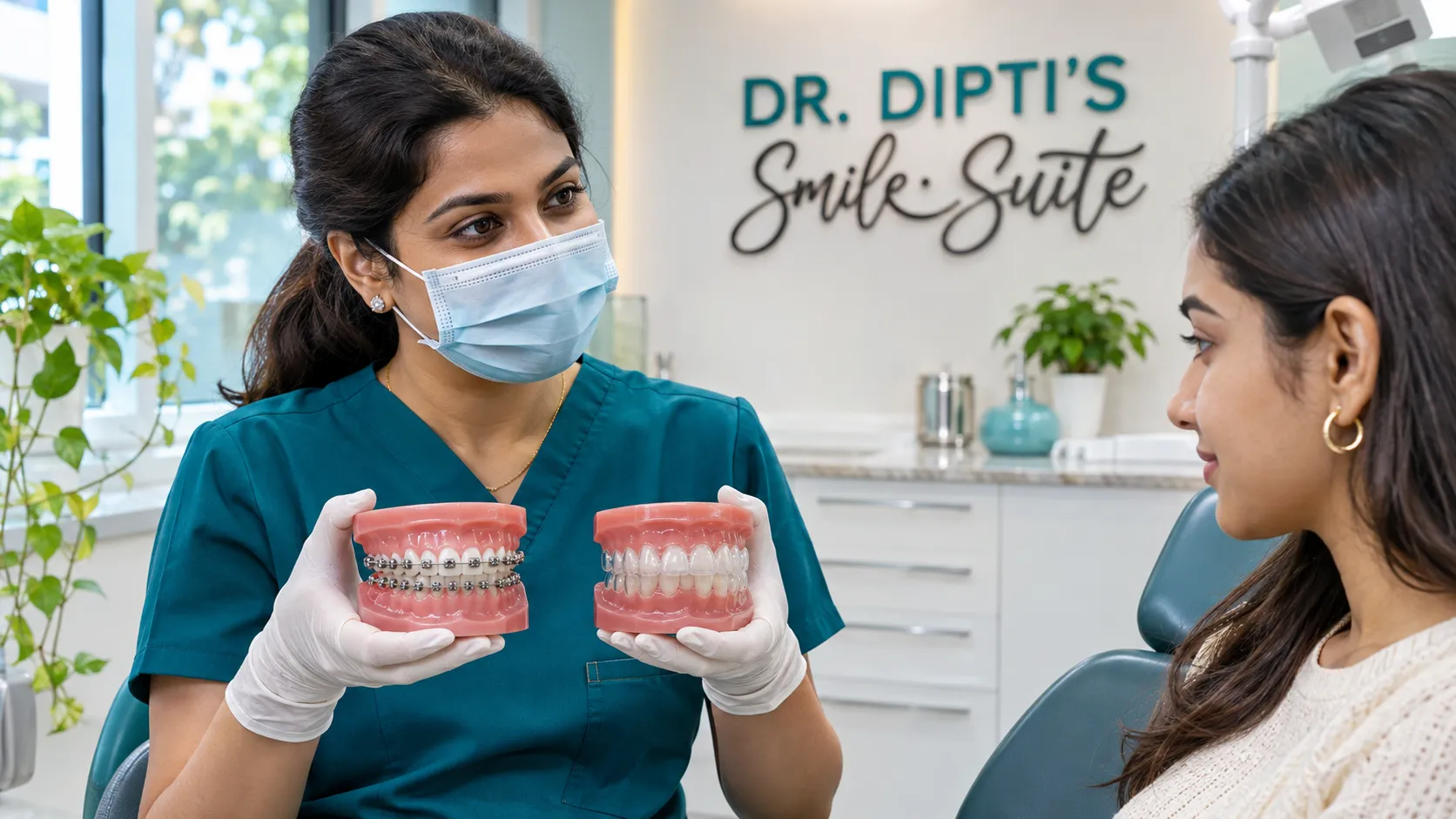
Metal brackets are bonded to each tooth and connected with a wire that is adjusted every few weeks. Metal braces are the most established, most versatile and usually the most affordable option. They work 24 hours a day without depending on you to wear them.
Ceramic braces
These work like metal braces but use tooth-coloured or clear brackets, so they are much less visible. They are a popular middle path for adults and teenagers who want fixed treatment with better looks.
Invisalign clear aligners
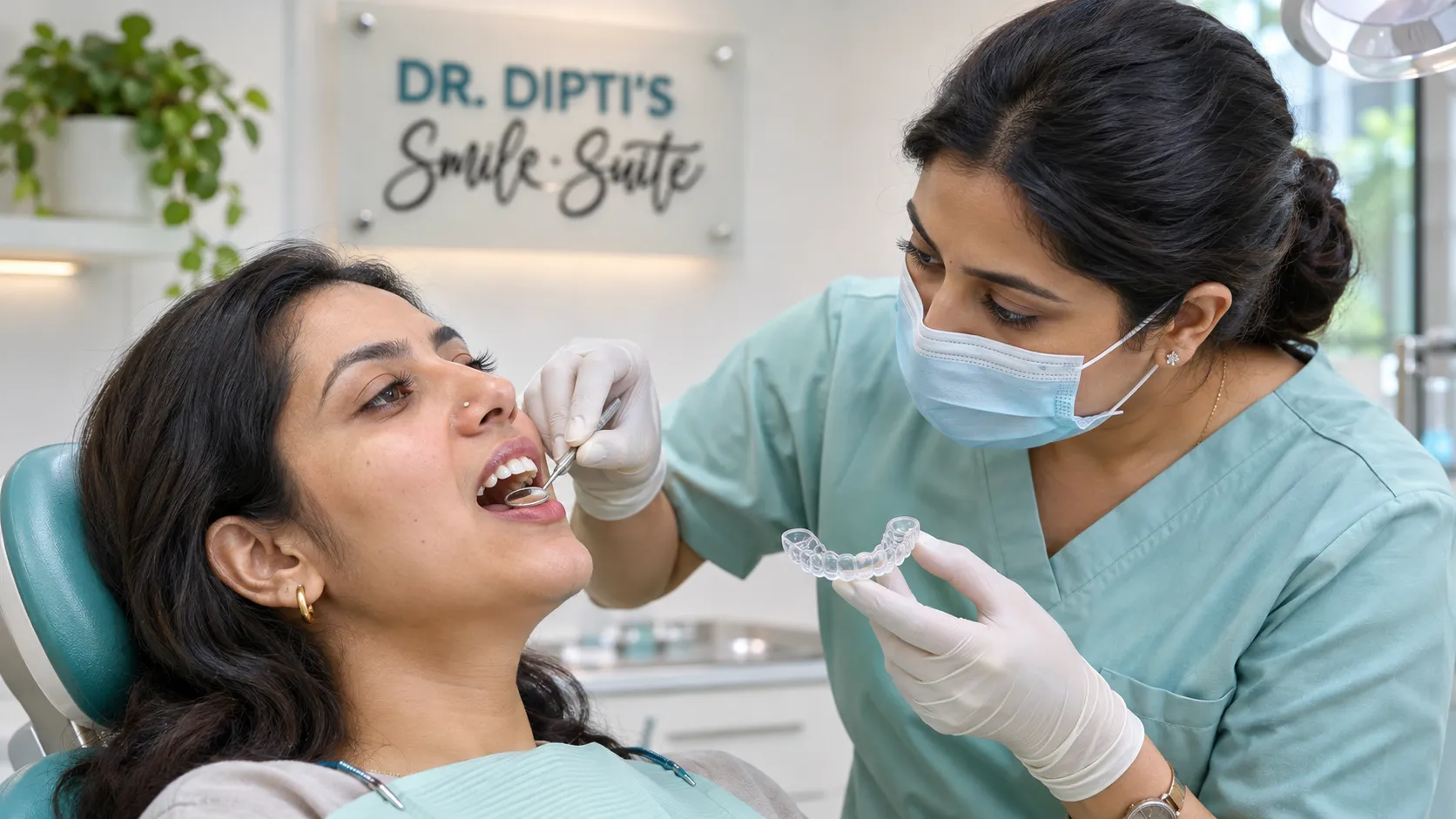
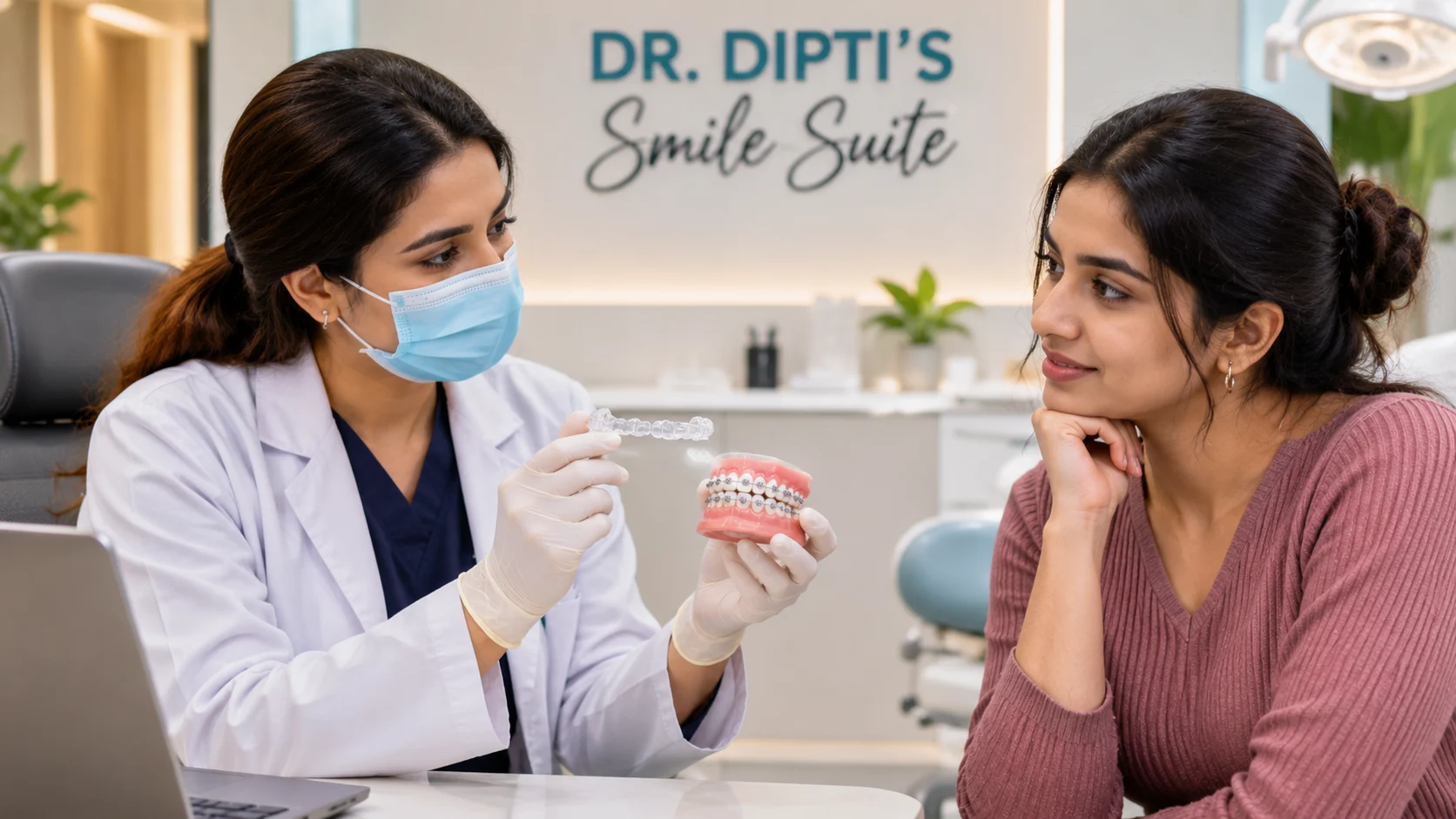
Invisalign uses a series of custom-made, almost invisible plastic trays. Each set moves the teeth slightly, and you switch to a new set every one to two weeks. The full treatment is planned digitally before it starts, so you can see a simulation of the expected result. Small tooth-coloured bumps called attachments may be bonded to some teeth to help the aligners grip and move them precisely.
Dr. Dipti’s Smile Suite is a Black Diamond Invisalign provider, one of the highest provider levels, which reflects extensive Invisalign experience.
Explore: Invisalign Aligners in Faridabad | Orthodontics in Faridabad
At a glance
| Feature | Metal braces | Ceramic braces | Invisalign aligners |
|---|---|---|---|
| Visibility | Clearly visible | Much less visible | Nearly invisible |
| Removable | No | No | Yes |
| Depends on you wearing it | No | No | Yes, 20–22 hours a day |
| Eating | Avoid hard and sticky foods | Avoid hard and sticky foods | Remove to eat; no food limits |
| Brushing and flossing | Harder; needs special tools | Harder; needs special tools | Easy; remove aligners to clean |
| Comfort | Wires and brackets can rub | Similar to metal | Smooth; pressure with each new set |
| Clinic visits | Every 4–6 weeks for adjustment | Every 4–6 weeks | Fewer adjustments; progress checks |
| Complex bite problems | Very versatile | Very versatile | Suits many cases; some need extra help |
| Typical cost | Lowest | Moderate | Highest |
What Does the Research Say About Braces vs Aligners?
Both options work. They have different strengths.
A 2019 systematic review in BMC Oral Health found that clear aligners and braces were both effective at treating malocclusion. In the studies analysed, aligner patients had a shorter overall treatment time. The review also found that braces were better at producing ideal contact between the back teeth, controlling root angulation, widening the arches, and staying stable afterwards.
A 2020 review in Orthodontics & Craniofacial Research concluded that aligners can produce results comparable to braces for front-tooth angulation in mild to moderate cases. It also noted that many tooth movements need more than one set of aligners to finish, which is why refinement aligners are common.
In practice, this means Invisalign is an excellent choice for a large share of patients. More complex bite corrections may need braces, or aligners combined with additional techniques, and in every case a well-planned retention phase matters.
Questions to Ask Yourself Before Choosing
1. How complex is my case?
Mild to moderate crowding, spacing, relapse after old braces, and many bite problems respond very well to Invisalign. Severe rotations, large vertical movements, significant jaw discrepancies and some extraction cases may be more predictable with braces. Your dentist should explain this honestly after examining you.
2. Will I really wear aligners 20 to 22 hours a day?
This is the most important question for Invisalign. Aligners only work while they are in your mouth. If you tend to forget, remove them for long meals, or leave them out during social events, your teeth will not move as planned. If you are not confident about this, braces may suit you better because they work automatically.
3. How much does appearance matter during treatment?
Think about the next 12 to 24 months. Do you present to clients, appear on camera, or have a wedding, engagement or major event coming up? Many adults choose Invisalign or ceramic braces for this reason.
4. What are my food and drink habits?
With aligners, you must remove them to eat or drink anything except plain water, then brush before putting them back. Frequent snacking and many cups of chai through the day can make this hard to manage. With braces you can eat at any time, but you must avoid hard and sticky foods like bhutta, nuts, toffees and hard rotis torn with the front teeth.
5. How good is my oral hygiene right now?
Braces make cleaning harder, and plaque around brackets can leave white spots on the enamel. Aligners make brushing and flossing easier, but if you put them back over unbrushed teeth, food and sugar are trapped against the teeth for hours. Either way, gum disease and cavities should be treated before starting.
Read more: How to Stop Bleeding Gums at Home and When to Get Help
6. Do I play sports, travel often or play a wind instrument?
Aligners can be removed for wind instruments and are smoother during contact sports, although a mouthguard is still wise. Frequent travellers often prefer aligners because emergency visits for broken brackets or poking wires are less likely.
7. What is my budget, and what does the price include?
Invisalign usually costs more than metal braces, with ceramic braces in between. When comparing quotes, check that the total covers everything: records, X-rays, scans, all aligners, refinements, attachments, visits and retainers.
Read more: Braces Cost in Faridabad: Metal vs Ceramic vs Invisalign Price Comparison | Is ₹1.5 Lakh for Invisalign Worth It
8. Am I ready to wear a retainer long-term?
Teeth naturally tend to drift back after treatment. Whether you choose braces or Invisalign, you will need retainers afterwards, usually worn at night for the long term. If you are not prepared for this, the result will not last.
Questions to Ask Your Dentist Before You Start
A good consultation should answer all of these clearly. If it doesn’t, ask.
- Who will plan and supervise my treatment, and what is their experience? Ask how many similar cases the team has treated.
- Am I a good candidate for Invisalign, or would braces give me a better result? A good dentist will tell you honestly, even if the answer is braces.
- Can I see a digital simulation of my expected result? Invisalign treatment is planned in 3D, so you can preview tooth movements before committing.
- How long will treatment take, realistically? Ask for a range, and what could make it longer.
- Will I need extractions, attachments or IPR? IPR (interproximal reduction) means polishing a very thin layer of enamel between some teeth to create space. Ask why and where.
- How many refinement aligners are included? Many cases need extra aligners to fine-tune the result. Check whether they are included in the price.
- What exactly is included in the total cost? Records, scans, X-rays, aligners or brackets, visits, emergency repairs, whitening offers, and retainers.
- How often will I need to visit? Braces usually need adjustments every 4 to 6 weeks; aligners need fewer but regular progress checks.
- What happens if I lose or break an aligner, or a bracket comes off?
- What is the retention plan? Which type of retainer, for how long, and what does a replacement cost?
- Does anything else in my mouth need treatment first? Cavities, gum disease, old crowns or missing teeth may need attention before or alongside orthodontics.
When Braces May Be the Better Choice
- Severe crowding, rotations or vertical tooth movements
- Significant bite or jaw problems
- Younger children or teens who may not wear aligners reliably
- Patients who want the lowest-cost option
- People who know they will not manage 20 to 22 hours of daily aligner wear
When Invisalign May Be the Better Choice
- Mild to moderate crowding or spacing
- Teeth that moved after old braces
- Adults and teens who want a discreet option for work, college or events
- Patients who want easier brushing and flossing
- People who travel often or prefer fewer clinic visits
- Patients combining straightening with cosmetic treatment such as whitening, veneers or implants
Straightening Teeth as an Adult
Many of our orthodontic patients are in their 30s, 40s and 50s. Adult treatment works very well, with a few extra considerations.
Gum health comes first. Gum disease must be treated and stable before teeth are moved.
Orthodontics can make cosmetic and restorative work easier. As a prosthodontist, I often plan aligner treatment before veneers, crowns or implants. Moving teeth into better positions first can mean less tooth reduction for veneers, better spacing for an implant, and a more natural final result. This is a key part of how we plan digital smile makeovers.
Explore: Smile Makeover in Faridabad | Dental Veneers in Faridabad | Dental Implants in Faridabad
Bite and jaw comfort matter. Patients with jaw joint (TMJ) discomfort or heavy wear from grinding need careful bite planning, an area in which Dr. Dipti has special clinical interest.
Whitening fits naturally. Your aligners can be used as whitening trays towards the end of treatment, or you can choose professional Zoom whitening once treatment is complete.
Explore: Teeth Whitening in Faridabad
Children and Teenagers
We recommend an orthodontic check for children by around age seven. At this age, some problems, such as a narrow upper jaw, crossbites, or habits like thumb sucking, can be guided while the child is still growing. This can sometimes make later treatment simpler.
For teenagers, both braces and Invisalign are options. The deciding factor is often how responsibly the teen will wear and care for aligners. Parents know their children best, and we discuss this openly at the consultation.
Read more: Thumb Sucking and Its Effect on Kids Teeth | Explore: Pediatric Dentistry in Faridabad
After Treatment: Retainers Are Not Optional
Whatever you choose, the end of active treatment is the start of retention. Teeth have a natural tendency to move back towards their old positions, especially in the first year.
- Removable clear retainers look like thin aligners and are usually worn at night
- Fixed (bonded) retainers are thin wires attached behind the front teeth
Most patients need to wear retainers at night for the long term. A few nights a week can be enough later on, but stopping completely often allows the teeth to shift. If your teeth have already moved after old braces, Invisalign can usually correct this, and then a proper retention plan keeps them in place.
How We Help You Decide at Dr. Dipti’s Smile Suite
At your orthodontic consultation, we:
- Listen to your goals: what bothers you, your timeline, and any events ahead.
- Examine your teeth, gums, bite and jaw joints.
- Take digital X-rays and a 3D scan instead of messy impressions wherever possible.
- Show you your options honestly: metal braces, ceramic braces or Invisalign, and which suits your case best.
- Show a digital simulation for Invisalign-suitable cases, so you can see the expected result.
- Give you a clear, all-inclusive cost and timeline before anything begins.
We will tell you if braces are the better option for you, even if you came in asking for Invisalign. A good result matters more than the type of appliance.
Book Your Braces or Invisalign Consultation in Faridabad
The best orthodontic choice is not the one your friend picked or the one with the best advertisement. It is the one that fits your teeth, your habits and your goals, and that you will follow through to the end, retainers included.
If you are considering straighter teeth, book a consultation at Dr. Dipti’s Smile Suite. We will assess your case, show you your options side by side, and help you choose with complete clarity on results, timelines and costs.
Dr. Dipti’s Smile Suite
SCF 142, Sector 14, HUDA Market, Faridabad, Haryana 121007
Call / WhatsApp: +91 88828 50066
Monday to Saturday: 10:00 AM – 3:00 PM and 5:30 PM – 8:00 PM