Knowing what to do if you chip or break a tooth in the first hour makes a real difference. A small chip is rarely an emergency. A tooth that is knocked out is one of the most time-sensitive situations in dentistry, and the right first aid can be the difference between saving it and losing it.
Tooth injuries are far more common than most people realise. A 2018 meta-analysis in Dental Traumatology estimated that 15.2% of people have had an injury to a permanent tooth and 22.7% to a baby tooth. The authors concluded that about one billion living people have had a dental injury.
This guide covers:
- Step-by-step first aid for chips, cracks, breaks and knocked-out teeth
- How to tell an emergency from a problem that can wait a day or two
- How each type of damage is repaired, from same-day bonding to crowns, root canal treatment and implants
First, Check: Is This a Medical Emergency?
Before thinking about the tooth, check the person. Go to a hospital emergency department straight away if the injury involves any of these:
- A blow to the head, loss of consciousness, confusion, vomiting or severe headache
- A jaw that cannot open or close normally, or teeth that suddenly do not meet properly
- Bleeding from the mouth that does not stop after 15 to 20 minutes of firm pressure
- Rapidly increasing swelling of the face or neck, or difficulty breathing or swallowing
- Deep cuts to the lips, tongue or face
Teeth can be treated once the person is safe. If a tooth has been knocked out, take it with you in milk to the hospital (see below).
Types of Chipped and Broken Teeth
Not every break is the same. The type of damage decides how urgent it is and how it will be repaired.
Craze lines
These are fine, surface-level lines in the enamel, common in adult teeth. They do not hurt and usually need no treatment beyond monitoring. They can be polished or covered for cosmetic reasons.
Minor enamel chip
A small piece of the outer enamel breaks off, often at the edge of a front tooth. There is usually no pain, only a rough or sharp edge. This is not urgent, but it should be repaired before the edge cuts your tongue or the chip grows.
Chip into the dentine
A deeper break exposes the yellowish dentine under the enamel. The tooth is often sensitive to cold, air and sweet foods. See a dentist within a day or two, because exposed dentine lets bacteria move towards the nerve.
Break exposing the nerve
If you see a pink or red spot or bleeding from the centre of the broken tooth, the nerve (pulp) is exposed. This is usually painful and needs prompt dental care, ideally the same day.
Cracked tooth
A crack can run from the biting surface down towards the root without any piece breaking off. The classic sign is sharp pain when you bite down, especially when you release the bite, along with sensitivity to cold. Cracks are often invisible to the eye and tend to get worse with time.
Broken cusp
One of the pointed corners of a back tooth breaks off, often a tooth that already had a large filling. It may or may not hurt, but the tooth is weakened and needs protection.
Loose or displaced tooth
After a blow, a tooth can be pushed in, pushed out, or knocked sideways while staying in the mouth. This needs same-day dental care so the tooth can be repositioned and stabilised.
Knocked-out tooth (avulsion)
The whole tooth, including the root, comes out of its socket. This is a true dental emergency for a permanent (adult) tooth. Every minute counts.
What to Do Immediately After You Chip or Break a Tooth
For chips, cracks and broken pieces, follow these steps while you arrange to see a dentist.
Step 1: Rinse and look
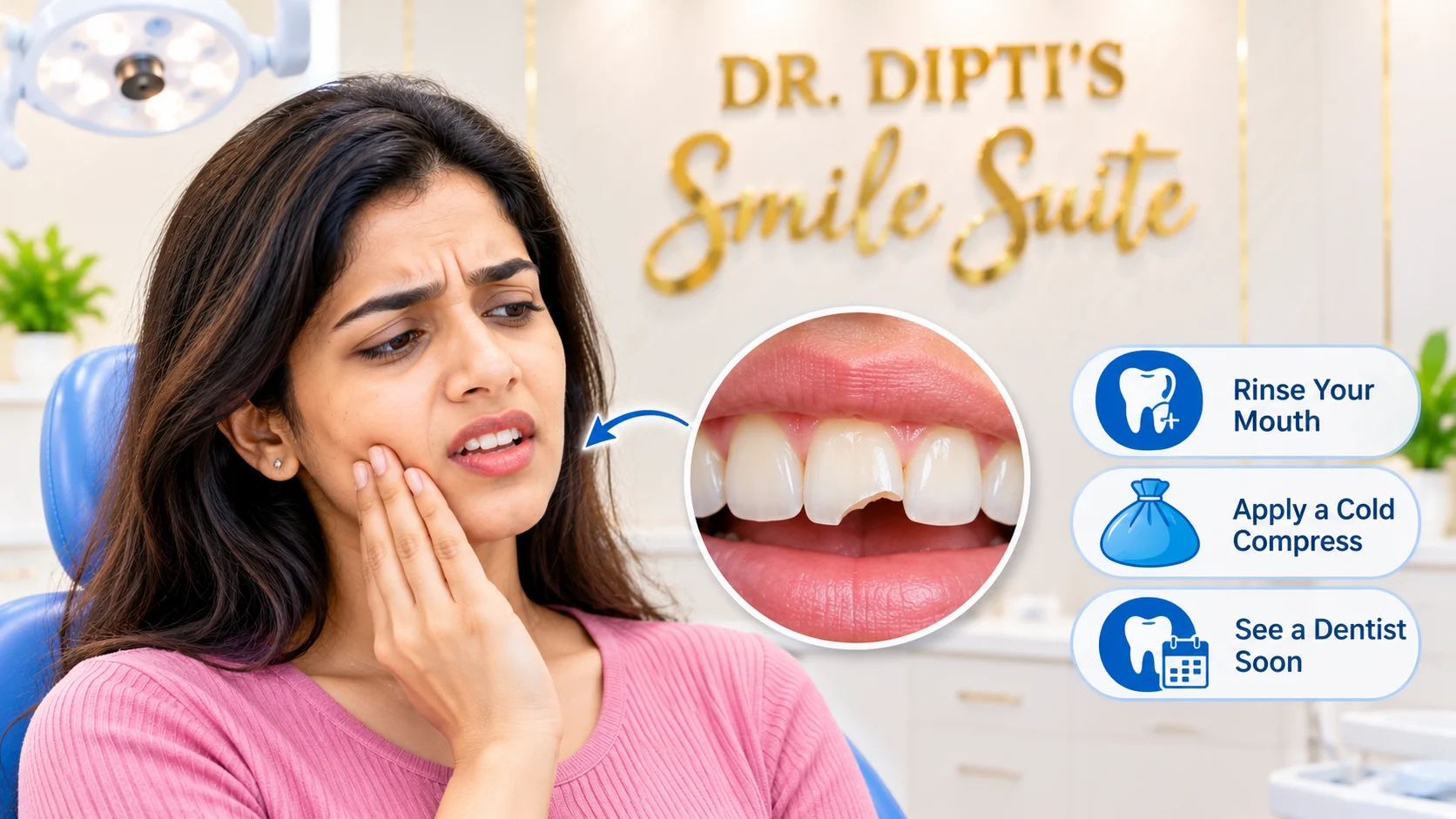
Rinse your mouth gently with lukewarm water. Look in a mirror to see what is broken and whether there is bleeding, a visible pink spot, or a loose tooth.
Step 2: Save any broken pieces
If you find the broken fragment, keep it in a small container of milk or saliva and bring it with you. In some cases, a clean fragment can be bonded back onto the tooth.
Step 3: Control bleeding
Press a clean, damp gauze or cloth on the area for 10 minutes. A damp tea bag also works, because tea contains tannins that help blood clot.
Step 4: Reduce pain and swelling
Hold a cold compress or ice wrapped in a cloth against the cheek for 10 to 15 minutes at a time. An over-the-counter pain reliever, taken exactly as directed on the label, can help. Do not place aspirin or any tablet directly on the gum or tooth, as it burns the tissue.
Step 5: Protect the sharp edge
Cover a jagged edge with sugar-free chewing gum or orthodontic wax from a pharmacy so it does not cut your tongue or cheek. Pharmacy temporary dental filling kits can cover a rough area for a day or two. They are a short-term shield, not a repair.
Step 6: Eat carefully until you are seen
Chew on the other side, choose soft foods, and avoid very hot, very cold, sticky or hard foods. Do not bite on the damaged tooth to “test” it, because this can turn a crack into a split.
What to Do If a Tooth Is Knocked Out
The first hour matters most. These steps follow the International Association of Dental Traumatology (IADT) 2020 guidelines for permanent teeth.
Step 1: Find the tooth and hold it by the crown
Pick it up by the white biting part (the crown). Never touch the root, because the delicate cells on it are needed for the tooth to reattach.
Step 2: Clean it only if it is dirty
If it is dirty, rinse it briefly in milk or saline. The 2020 update no longer advises rinsing with water. Do not scrub it, wipe it, or wrap it in tissue.
Step 3: Put it back in the socket if you can
The best results come from replanting the tooth within about 15 minutes. Push it gently back into the socket the right way round, then bite softly on a handkerchief or gauze to hold it in place.
Step 4: If you cannot replant it, keep it moist
Place the tooth in milk. The IADT ranks storage media in this order:
- Milk
- A tooth-storage solution (Hank’s balanced salt solution, HBSS)
- Saliva (spit into a small container)
- Saline
Water is a poor choice but still better than letting the tooth dry out. Never let the tooth dry out. Once a tooth has been out of the mouth and dry for 60 minutes or more, the cells on the root are no longer viable.
Step 5: Reach a dentist immediately
Call ahead so the clinic is ready for you. After replantation, the dentist splints the tooth to its neighbours, usually for about two weeks. For a fully formed adult tooth, root canal treatment is generally needed within two weeks.
Important: do not replant a baby tooth
A knocked-out milk tooth should not be pushed back in, because it can damage the adult tooth developing underneath. Keep the tooth, comfort the child, control any bleeding, and see a dentist the same day to check for other injuries.
How Dentists Repair a Chipped or Broken Tooth
Treatment depends on how much tooth is lost, whether the nerve is involved, and where the tooth sits in the mouth. At Dr. Dipti’s Smile Suite, we start with a clinical examination and digital X-rays to check the root, the nerve and the surrounding bone. We then recommend the most conservative repair that will last.
Polishing and smoothing
Tiny enamel chips and craze lines can often be smoothed and polished in a few minutes, with no drilling or anaesthesia.
Composite bonding
Tooth-coloured composite resin is shaped directly onto the tooth to rebuild a chipped edge or corner. It is matched to your natural shade, completed in a single visit, and usually needs little or no removal of healthy tooth. When the original fragment has been saved in good condition, we can sometimes bond it back in place.
Explore: Composite Filling in Faridabad
Dental veneers
When a front tooth has a larger chip, or several front teeth are chipped and uneven, a porcelain veneer covers the front surface. It restores shape, strength and colour with a very natural look and good stain resistance.
Explore: Dental Veneers in Faridabad | Read more: Dental Veneers in Faridabad: Cost and Procedure
Dental crowns
When a large part of the tooth is broken, a cusp has fractured, or a crack needs to be held together, a crown covers the whole tooth and protects it from further damage. We design and make many crowns on-site using CAD/CAM technology, so suitable cases can be finished in a single visit through our one-day dentistry approach.
Explore: Dental Crowns and Bridges in Faridabad | Read more: Teeth Cap Price in India: Dental Crown Cost by Type
Root canal treatment
If the break exposes or damages the nerve, or a crack has let infection reach the pulp, root canal treatment removes the damaged tissue, disinfects the canals and seals the tooth. A crown is usually placed afterwards to protect it. The procedure is done under local anaesthesia and saves the natural tooth.
Explore: Root Canal Treatment in Faridabad | Read more: Root Canal Treatment Cost in Faridabad: A Clear Price Guide
Extraction and dental implants
Some teeth cannot be saved, such as a tooth split down the middle or one broken below the gumline. In these cases, gentle extraction followed by a dental implant gives a permanent replacement that looks and works like a natural tooth. In selected cases, a tooth can be placed on the implant on the same day, so you never leave the clinic with a visible gap.
Explore: Dental Implants in Faridabad | Oral Surgery in Faridabad
Bridges
Where an implant is not suitable, a dental bridge replaces the missing tooth by anchoring a false tooth to the neighbouring teeth.
Full mouth rehabilitation and smile makeover
When several teeth are chipped or worn down, often from years of grinding, repairing one tooth at a time rarely lasts. Full mouth rehabilitation rebuilds the bite as a whole. A digitally planned smile makeover restores both appearance and function together.
Explore: Smile Makeover in Faridabad | Cosmetic Dentist in Faridabad
Quick guide: damage and matching treatment
| Type of damage | How urgent | Usual treatment |
|---|---|---|
| Craze lines | Not urgent | Monitoring, polishing if needed |
| Small enamel chip | Within 1–2 weeks | Smoothing or composite bonding |
| Chip into dentine, sensitive | Within 1–2 days | Composite bonding or veneer |
| Large break, broken cusp | Within 1–2 days | Crown, sometimes same day with CAD/CAM |
| Nerve exposed (pink spot) | Same day | Root canal treatment, then crown |
| Cracked tooth, pain on biting | Within 1–2 days | Crown; root canal if the nerve is affected |
| Loose or displaced tooth | Same day | Repositioning and splinting |
| Knocked-out adult tooth | Immediately | Replantation, splint, root canal |
| Tooth split or broken below gum | Within 1–2 days | Extraction and implant or bridge |
Chipped and Broken Teeth in Children
Children chip teeth often, especially between ages two and four as they learn to walk and climb, and again during sports and play. The approach differs between baby teeth and adult teeth.
- Baby teeth: small chips may only need smoothing. Deeper breaks may need a child-friendly filling or a pulp treatment. Knocked-out baby teeth are not replanted.
- Young adult teeth: these have wide-open roots and good healing potential. Keeping the nerve alive matters, because it allows the root to keep growing and strengthening.
- Watch for colour change: a tooth that turns grey, yellow or dark weeks after an injury may have a damaged nerve and should be checked.
Our pediatric dentistry team treats injured teeth calmly and gently, and keeps follow-up visits comfortable for children and parents.
Explore: Pediatric Dentistry in Faridabad
What Happens If You Ignore a Chipped or Broken Tooth
A painless chip can feel easy to put off, but untreated damage tends to get worse:
- Small cracks spread with every bite and can split the tooth down to the root
- Exposed dentine invites decay and sensitivity
- Bacteria can reach the nerve, leading to infection, abscess and swelling
- A sharp edge can cut the tongue and cheek repeatedly
- A tooth that could have been saved with a filling may later need a root canal and crown, or extraction
Early repair is almost always simpler, quicker and less expensive.
How to Prevent Chipped and Broken Teeth
- Wear a mouthguard for sports. Cricket, hockey, football, basketball, boxing and cycling all carry risk. A custom-fitted mouthguard is more comfortable and protective than a store-bought one.
- Treat grinding and clenching. A custom night guard protects teeth that are being worn and cracked during sleep.
- Do not use your teeth as tools. Avoid opening bottles, tearing packets or biting thread with your teeth.
- Be careful with hard foods. Ice, hard candy, unpopped popcorn kernels, bones and supari are common causes of fractured teeth.
- Restore weak teeth early. Teeth with large old fillings or root canal treatment without a crown break more easily. A crown can prevent a fracture.
- Correct protruding front teeth. A 2015 meta-analysis found that a large overjet (front teeth sticking out) may double or even triple the risk of injury to the front teeth. Orthodontic treatment with braces or Invisalign clear aligners brings those teeth back into a safer position.
Explore: Invisalign Aligners in Faridabad | Orthodontics in Faridabad
Get Help for a Chipped or Broken Tooth in Faridabad
The first hour after a dental injury decides a lot. Keep any broken piece or knocked-out tooth moist in milk, protect the area, and get a professional assessment quickly. Most chipped and broken teeth can be restored so well that nobody can tell they were ever damaged, often in a single visit.
If you have chipped, cracked or broken a tooth, call or WhatsApp us. We will advise you on the next steps right away and arrange to see you as soon as possible.
Read more: How To Find Emergency Dental Services In Faridabad
Dr. Dipti’s Smile Suite
SCF 142, Sector 14, HUDA Market, Faridabad, Haryana 121007
Call / WhatsApp: +91 88828 50066
Monday to Saturday: 10:00 AM – 3:00 PM and 5:30 PM – 8:00 PM