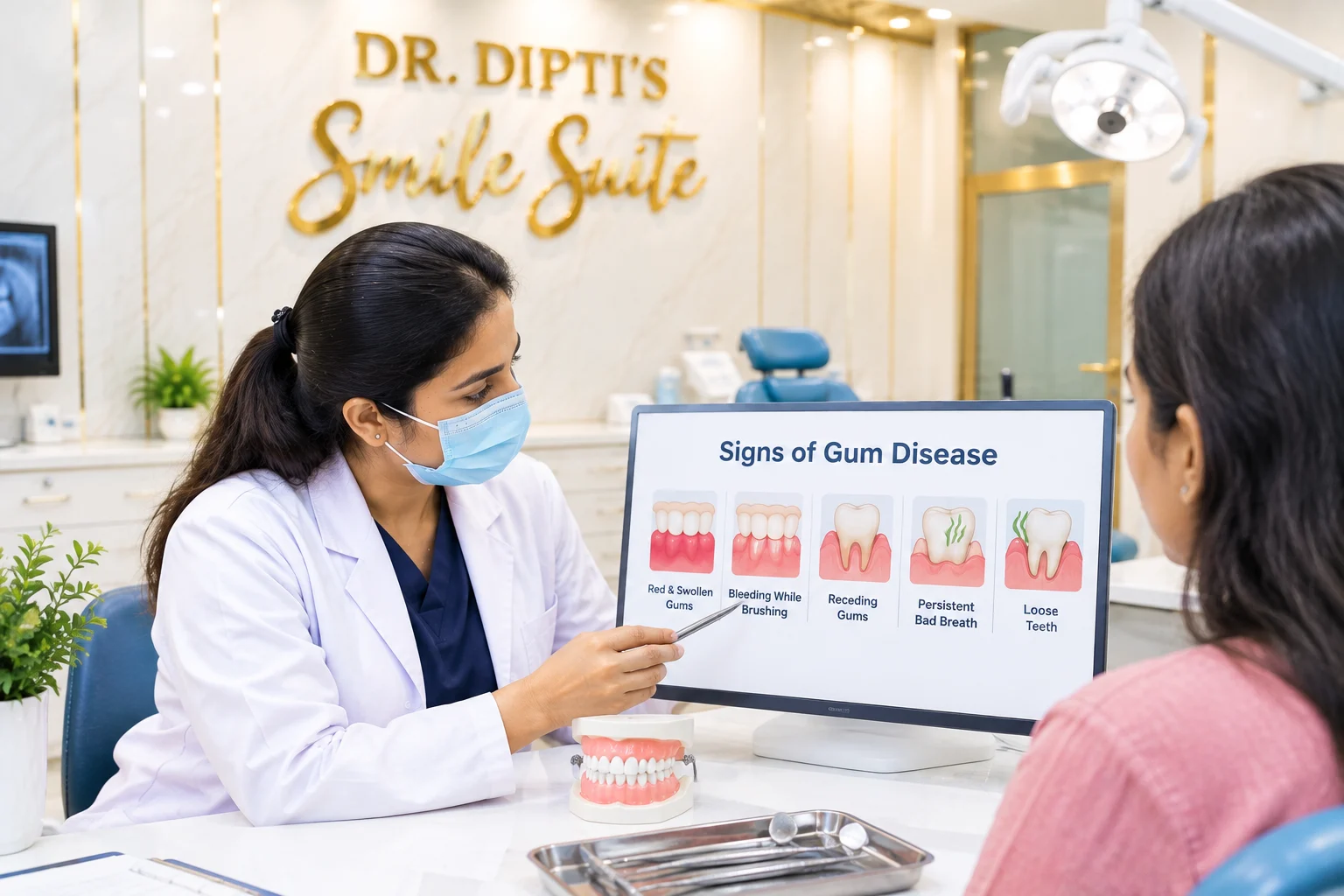
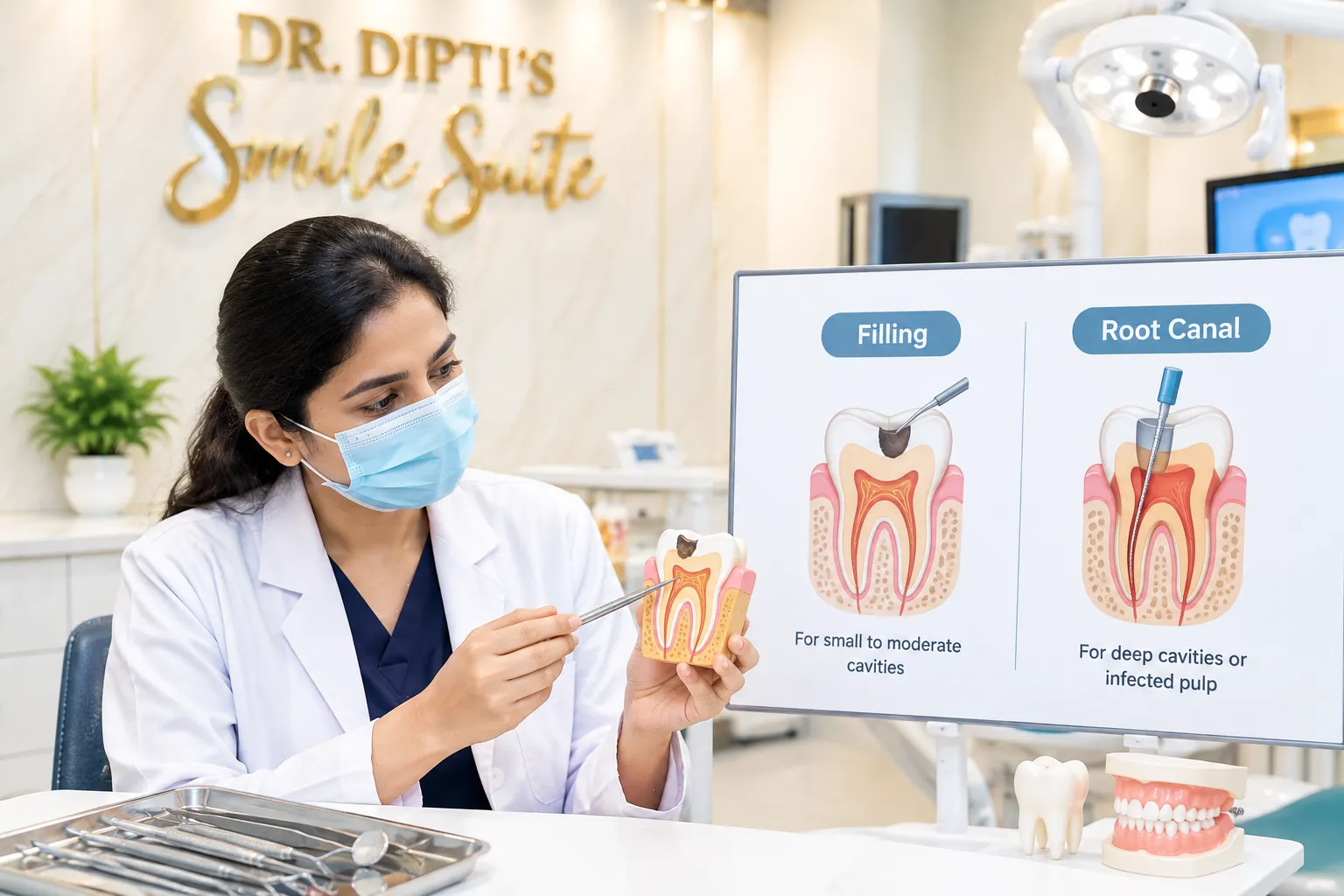
People that walk in to Dr. Dipti Smile Suite with tooth pain have similar questions. “Is this a deep cavity?” People are obviously anxious to know the worst, but the best case scenario is a small cavity.
A tooth can be a very poor indicator of its status. Often times, the only way to know for sure is to have an x-ray. In the meantime, an analysis of the signs your tooth is exhibiting is a good indicator of your dental health. This article will explain some of those indicators and what to expect when you see a dentist. We will explain the processes of a tooth filling and a root canal in detail.
A Quick Story Most Patients Will Recognise
Last year, a patient in our Faridabad clinic was convinced she was in need of a root canal. From her description, she was obviously anxious to receive a root canal. However, after Dr. Dipti took a look, it was determined she only had a moderately deep cavity and the tooth still contained a nerve. In less than 30 minutes, Dr. Dipti restored the tooth with a composite filling.
Another patient was under the impression he would just need a “quick filling” to alleviate the discomfort he was feeling in a tooth. When the decay had gotten into the pulp of the tooth, Dr. Dipti explained to the patient and his father that a root canal treatment would be necessary to alleviate the infection and save the tooth.
Many people think they know what their teeth need, but that is not always the case. That is why professional dental examinations are necessary and guess work should be avoided. Pain and symptoms are not always an accurate indication of the state of the tooth.
Understanding What Is Actually Happening Inside Your Tooth
To explain these procedures, it is essential that we briefly review tooth anatomy.
All teeth have three layers.
- The outermost layer is enamel.
- The next layer is dentin.
- The innermost layer is the pulp. The pulp contains the nerve and blood supply of the tooth.
Usually when a cavity is forming, it starts in the enamel. A small cavity in the enamal can be treated with a simple filling. However if the cavity is not treated, the decay will spread to the next layer (dentin) and then to the pulp. If the decay reaches the pulp, it is called a “nerotic” or “irreversible” pulpitis. At this stage, a simple filling will not treat the cavity and a more complicated dental procedure called “a root canal” will be necessary. A “root canal” will remove the infected tissue of the pulp.
Symptoms That Usually Point to a Filling
Not all tooth pain indicates a major problem, and in some cases you can wait for your next regular dental appointment. Here are some signs that a cavity may exist that could be treated with a filling.
- Pain when eating something sweet or cold that goes away quickly
- Tooth decay may be present if you have a dark spot or a pit on the surface of your tooth.
- Discomfort when chewing
- Pain when a tooth is not being used
- Tooth sensitivity that has started recently
If you have one or more of the conditions listed above, it is likely you will need a filling. However, it is always best to contact your dentist and schedule a visit to have a professional evaluation. A small cavity can be painful and require a more significant treatment if it is left untreated.
Symptoms That Usually Point to a Root Canal
The following symptoms may indicate the infection is in the pulp of the tooth.
- Pain lasting minutes after the consumption of hot or cold foods/beverages
- Pain that occurs while sleeping and/or causes an inability to sleep
- Spontaneous pain
- Swelling of the gums that is tooth-specific and may even contain an inflammatory pus-filled (pimple-like) (gum) lesion
- Discoloration of the tooth (usually darkening and/or lightening to a grayish-hue)
- Tooth pain that is exacerbated by chewing or biting
- A tooth that is cracked/chipped, but may also contain an exposed (and therefore, re-pulpated) pulp
It is suggested that if three or more of the symptoms listed above are noticed/experienced, that an appointment be scheduled as soon as possible. Symptoms of pulpitis do not go away on their own. Often times, symptoms of untreated pulpitis allow the infection to spread and affect other structures of the body.
Root Canal vs Filling: A Simple Comparison
| Factor | Tooth Filling | Root Canal Treatment |
|---|---|---|
| Decay depth | Enamel or upper dentin | Reaches the pulp or nerve |
| Pain level before treatment | Mild, occasional | Often sharp, constant, or throbbing |
| Treatment time | Usually one short visit | Generally one to two visits |
| What is removed | Decayed tooth material only | Infected pulp tissue and nerve |
| Tooth sensation after | Normal sensation remains | Tooth may feel slightly different, often crowned |
| Long term outcome | Tooth remains fully intact | Tooth is saved but usually needs a crown for strength |
The aim of both of these treatments is to help you keep your natural tooth and not require an extraction.
A root canal treatment is less “bad” than people think. It’s actually more of a myth that makes root canals treatment worse than what the treatment actually is.
What Reallly Happens During Each Procedure
The Filling Procedure
- Cleans out decay with local anesthetic
- Shapes the cavity with different tools
- Checks the shape and size of the cavity with different tools
- Fills the cavity with tooth colored material
- Uses a special light to harden the material
- Smooths and shapes the material to match your tooth
- Checks your bite
- Polishes your tooth
Most people walk out in less than 30 minutes with little to no discomfort.
Root Canal Procedures
- First, local anesthesia is administered to numb the area.
- Next, an opening is drilled into the tooth to access the pulp.
- Pulp tissue is removed if it is infected or inflamed.
- To prepare the inside of the tooth, canals are shaped.
- The shaping of the canals helps determine the size of the material used to fill and seal the canals.
- A dental crown is placed on the tooth to protect and restore it to function.
Most patients report the root canal procedure is less uncomfortable than getting a filling. Local anesthesia is very effective in numbing the area. Many patients can’t remember the last time they had a root canal procedure because of how uncomfortable the procedure is. The process is often easier than dealing with the infection.
Myths and Realities of Root Canal Treatment
Myth: Root Canal treatment is very painful.
Fact: With anesthesia and other various techniques, the patients will not experience pain, but will feel a pressure-like feeling.
Myth: It is better to pull the tooth rather than have a root canal treatment.
Fact: It is better to keep your natural tooth and have a root canal treatment. This is better for chewing, and the alignment of the jaw, and for the facial structure.
Myth: If the pain goes away, the infection is healed.
Fact: Often, pain will go away with an infection, but this is not always the case. Pain will go away if the nerve has died, but this does not mean that the infection has healed.
Myth: Deep cavities can be healed with a filling.
Fact: Once the decay has gone into the pulp, a filling will not stop the infection.
What Happens If You Ignore the Symptoms
People often think pain will go away on its own. For an ache that comes and goes, it’s understandable to think that. Unfortunately, that’s not the case for tooth decay. A cavity gets larger and larger and will require a more complicated, and often painful, procedure to fix. A small cavity can be fixed with a simple filling. A large cavity may require a root canal. Neglecting that procedure will cause the surrounding tooth tissue to become infected and require the tooth to be removed.
It’s always best to see a dentist to evaluate the problem as soon as it’s noticed. The procedure to fix the problem will be less invasive and time consuming.
What Happens After a Dental Appointment
You should be able to go back to eating normally after a filling once the anesthetic numbness wears off. You may also experience sensitivity to hot and cold for a short period of time.
Expect tenderness when chewing for a few days after a root canal, and especially when putting pressure on the treated area. The tenderness should improve and disappear within a week. It is common to also have tenderness of the overlying gum tissue. Your endodontist will explain when you should return to have your permanent restoration (crown) placed.
Your endodontist will provide an honest account of what to expect. Most patients are happy to hear that your endodontist is addressing their tooth pain.
What to Consider Before Your Appointment
Jotting down the notes below will help your dentist determine the cause of your symptoms more quickly.
- Which tooth is causing you trouble?
- Is the trouble only caused or made worse by external stimuli (i.e. hot, cold, or sweet) ?
- Do you lose sleep because of the pain?
- Is there swelling?
- When did the symptoms begin?
- Is there any recent work being done or that has been done on the tooth?
The more of this information you can provide to your dentist, the more quickly your symptoms can be alleviated.
Prevention: Lessening the Probability of Treatment Needed
- Brush your teeth at least twice a day.
- Floss to remove plaque and food between your teeth.
- Choose healthy snacks and be careful when eating.
- Avoid using your teeth for other purposes.
- See your dentist once or twice a year for an examination and cleaning.
- See your dentist if you have an ache or feel pain or tenderness.
Untreated decay will increase your odds of needing more extensive treatment, such as a root canal.
The Reason Behind The Trust In Dr. Dipti Smile Suite
Dr. Dipti Goyal, having completed her clinical training in Prosthodontics and Implantology from India and the United States, is committed to providing the best treatment to her patients. Her aim is to provide treatment in a way that her patients are not unnecessarily exposed to any kind of unnecessary clinical procedure. At Smile Suite, all teeth requiring treatment are systematically assessed to decide if a treatment other than a root canal (i.e. a filling) is required.
The clinic has an state-of-the-art diagnostic aids and implements the latest techniques in dentistry to locate decay in teeth, and practices high standards of infection control to provide a safe environment to its patients. The staff explains every step of treatment to its patients in easy-to-understand language, thereby eliminating the need for patients to understand treatment terminology. The goal of the clinic is to treat teeth to keep them functional and cosmeticly pleasing. A root canal is often the first step in treating a decayed tooth.
Find out more about selecting the optimal clinic for root canal treatment in our detailed article - How to Pick the Best Root Canal Clinic in Faridabad. Also read the article, Why More People Are Choosing Root Canal Treatment in Faridabad Popular to understand the reasons for increasing acceptance for this treatment. If, in the course of diagnosis, we find that your treatment requirement is more of a minor restorative nature, then you may like to know about our Best Composite Filling in Faridabad service.
In the meantime, if you have any kind of tooth pain, do not assume that it will resolve on its own. It is better to book a consultation, and understand the reason for your pain. Our team will be happy to assist you at our Sector 14, Faridabad location.