If you've decided to straighten your teeth, the next question comes fast: braces or Invisalign? It's easily the most common thing people ask before starting orthodontic treatment, and the internet doesn't make it easier. Half the articles tell you aligners are the modern choice, the other half say braces are more reliable.
Here's the thing most of those pages won't tell you plainly: neither option is universally better. Both move teeth effectively. What actually decides the right answer is how complex your case is, how disciplined you are with wearing something 22 hours a day, and what you can comfortably spend.
This guide walks through the real differences in 2026, so you can figure out which one fits you instead of which one sounds better.
Still unsure which one your case needs?
Book a consultation with Dr. Dipti's Smile Suite and get a straight answer based on an actual examination, not guesswork.
Quick Answer: Which One Should You Pick?
Before the detail, here's the short version most people are looking for:
Choose braces if your case involves severe crowding, significant bite correction, or teeth that need major rotation or vertical movement. Also choose braces if you know you won't reliably wear a removable appliance, or if budget is your main constraint.
Choose Invisalign if your case is mild to moderate, appearance during treatment matters to you, and you can genuinely commit to 20 to 22 hours of daily wear. Also consider it if you play sports, present often at work, or simply hate the idea of food restrictions.
Now let's look at why.
How Each Treatment Actually Works
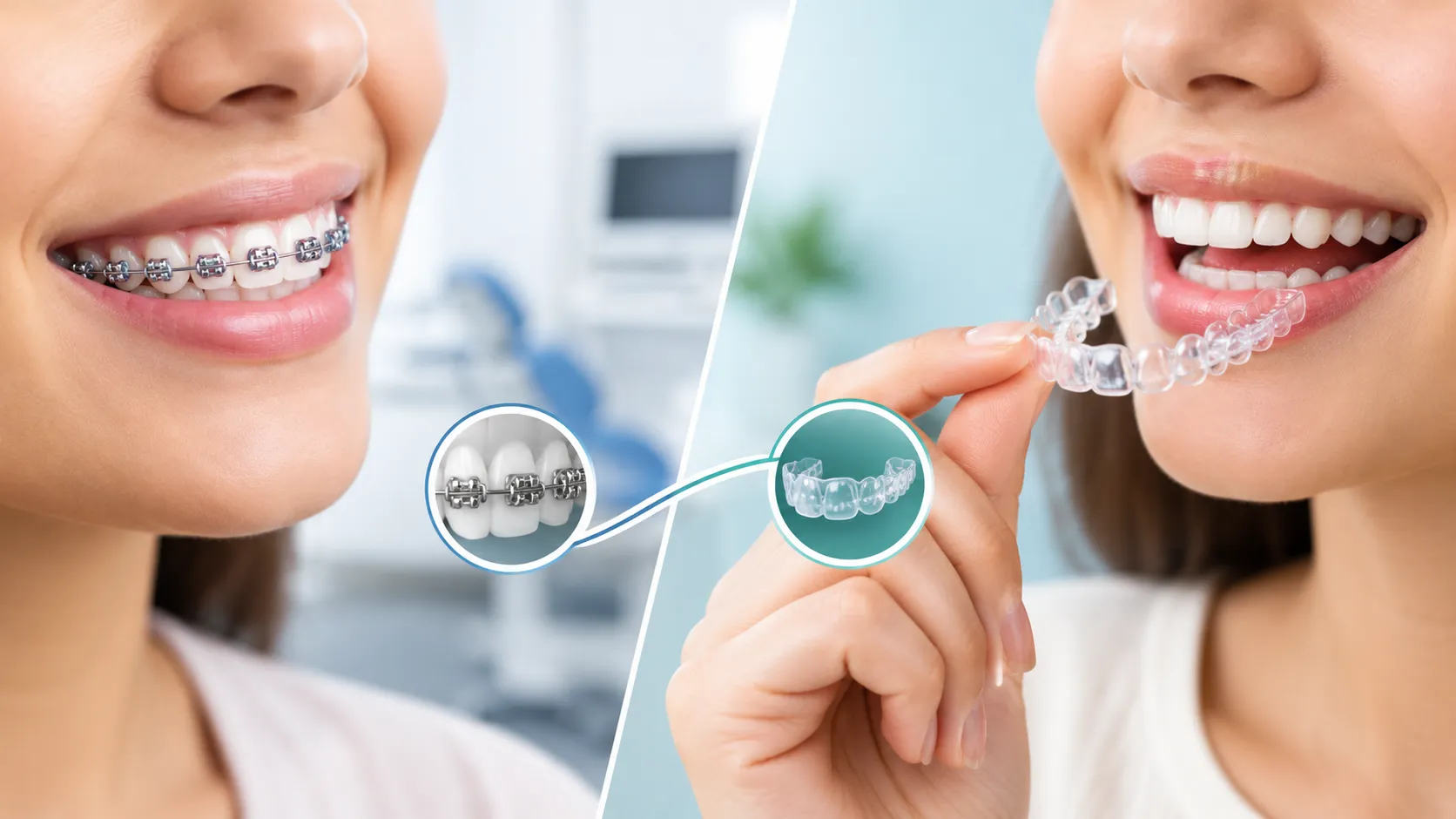
Traditional braces use brackets bonded to the front of each tooth, connected by a wire. Your orthodontist adjusts that wire periodically, and the continuous pressure moves teeth into position. Because the appliance is fixed to your teeth, it works whether you think about it or not.
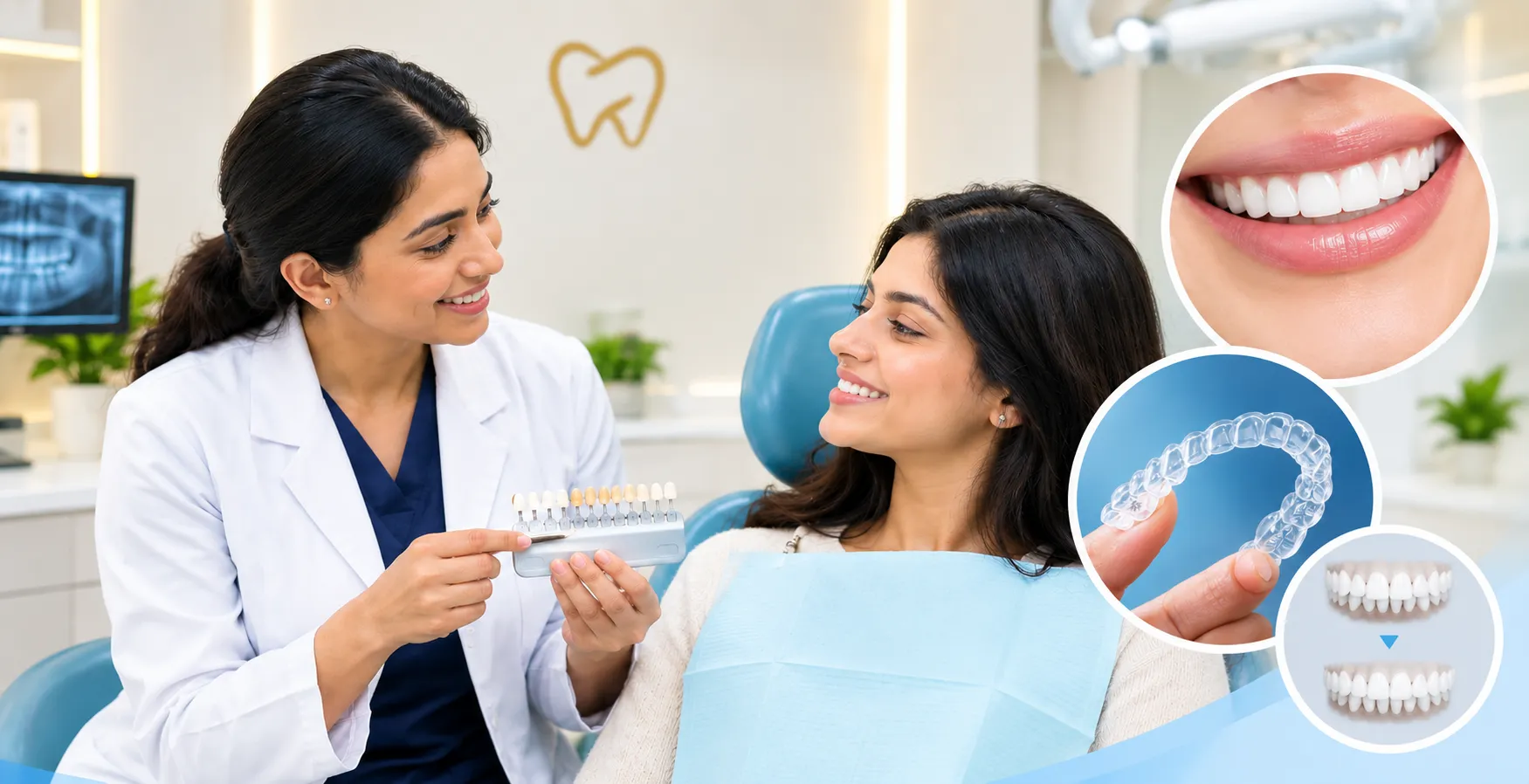
Invisalign uses a sequence of custom clear plastic trays. Each tray is slightly different from the last, and each one nudges your teeth a small step forward in the plan. You switch to a new tray every one to two weeks. Before treatment starts, your orthodontist creates a full digital simulation of your tooth movement, so you can see the projected end result before you begin.
The fundamental difference: braces apply constant force, while Invisalign applies force only when the trays are in your mouth. That single distinction explains almost every practical difference between them.
Braces vs Invisalign: The Real Comparison
| Factor | Traditional Braces | Invisalign |
|---|---|---|
| Cost in India | ₹30,000 – ₹80,000 (metal), ₹50,000 – ₹1,00,000 (ceramic) | ₹1,00,000 – ₹4,00,000+ |
| Treatment time | 18 – 36 months | 6 – 18 months (mild to moderate cases) |
| Appearance | Visible brackets and wires | Nearly invisible |
| Comfort | Brackets and wires can irritate cheeks and gums | Smooth plastic, mild pressure on tray changes |
| Removable | No | Yes |
| Food restrictions | Avoid hard, sticky, chewy foods | None, trays come out to eat |
| Oral hygiene | Harder to brush and floss around brackets | Easy, remove and brush normally |
| Discipline required | Low, they're always on | High, needs 20 – 22 hours daily wear |
| Best for complex cases | Yes, more control over difficult movements | Limited, depends on case |
| Clinic visits | Every 4 – 6 weeks for adjustments | Every 6 – 8 weeks for check-ins |
Cost: Where the Real Gap Is
In India, the price difference between the two is genuinely meaningful, unlike in some Western markets where the gap has narrowed considerably.
Metal braces typically run ₹30,000 to ₹80,000. Ceramic braces, which are tooth-coloured and less visible, sit around ₹50,000 to ₹1,00,000. Self-ligating braces, which need fewer adjustments, tend to fall between ₹70,000 and ₹1,20,000.
Invisalign generally starts around ₹1 lakh for very simple cases and runs up to ₹4 lakh or more for complex ones, with most people landing in the ₹1.5 lakh to ₹3 lakh range. If you want a full breakdown of what that ₹1.5 lakh actually pays for, we've covered it in detail here.
So you're often looking at Invisalign costing two to three times what metal braces would. That's a genuine consideration, not something to gloss over. What you're paying the premium for is the invisibility, the removability, the digital treatment planning, and the easier daily hygiene.
Worth knowing: other clear aligner brands exist in India at ₹40,000 to ₹1,00,000. They can work for very minor corrections, though they don't always match Invisalign's precision or track record for complicated movements.
Treatment Time: Not as Simple as "Invisalign Is Faster"
You'll see a lot of pages claim Invisalign is faster. That's partly true and partly misleading.
For mild to moderate cases with a compliant patient, Invisalign often finishes in 6 to 18 months, where comparable braces treatment might take 18 to 24 months. Research comparing the two has generally supported shorter average treatment periods with clear aligners in suitable cases.
But two things change that picture:
Compliance changes everything with Invisalign. The timeline assumes you're wearing the trays 20 to 22 hours a day, every day. If you routinely leave them out for long stretches, treatment stretches out, sometimes significantly. Braces don't have this problem because you can't take them off.
Complexity favours braces. For severe crowding, large gaps that need closing, or substantial bite correction, the continuous pressure of fixed braces often gets the job done more predictably, and sometimes faster.
Comfort and Daily Life
This is where Invisalign tends to win for most adults.
With braces, brackets and wires can rub against the inside of your cheeks, especially in the first weeks and after each adjustment. You avoid hard and sticky foods for the entire treatment period. Brushing and flossing around brackets takes real effort, and people who don't keep up with it risk plaque buildup and white spots on their teeth.
With Invisalign, you feel pressure for a day or two after switching trays, then it settles. You take them out to eat, so no food restrictions at all. You brush and floss normally. Most people describe it as noticeably less uncomfortable than braces.
The trade-off is discipline. You have to remember to put them back in after every meal, every snack, every cup of chai. You have to carry a case. You have to resist the temptation to leave them out "just for tonight." For some people that's easy. For others, particularly younger teens, it's the reason braces end up being the better call.
Which Cases Suit Which Treatment
Braces generally handle better:
- Severe crowding requiring significant movement
- Complex bite issues including deep overbites, underbites, and crossbites
- Teeth needing substantial rotation or vertical movement
- Cases involving extractions and large space closure
- Younger children and teens who need supervision rather than self-discipline
Invisalign generally handles well:
- Mild to moderate crowding
- Spacing and gaps between teeth
- Mild to moderate overbites and other bite corrections
- Relapse cases, where teeth shifted after earlier orthodontic work
- Adults who need a discreet option for professional or social reasons
The honest caveat is that this list keeps shifting. Aligner technology has expanded what's treatable over the past few years, and experienced providers now handle cases with Invisalign that would have been braces-only a decade ago. Your orthodontist's experience level matters here as much as the appliance itself.
The Factors People Forget to Consider
Retainers are non-negotiable, either way. Whichever treatment you choose, you'll need retainers afterwards. Teeth naturally drift back toward their old positions if nothing holds them. Ask whether retainers are included in your quote, because clinics vary on this.
Lost aligners cost money. If you misplace a tray, replacing it usually isn't free, and it can add a small delay to your timeline. People who lose things frequently should factor this in.
Braces may need emergency visits. Brackets come loose, wires poke. These are minor issues but they mean unscheduled trips to the clinic.
Insurance rarely covers either fully in India. Most Indian dental policies exclude orthodontic treatment or cover only a small portion. Check your specific policy, but don't build your budget around coverage.
EMI options exist for both. Most established clinics offer instalment plans, which can make Invisalign considerably more approachable than the sticker price suggests.
If you're weighing your options locally, it helps to understand what Invisalign treatment involves at a good clinic in Faridabad before you finalize anything.
What's Changed in 2026
A few things worth knowing if your information is a couple of years old:
Digital scanning has largely replaced messy physical impressions at most quality clinics, for both braces and aligner planning. Treatment simulations have become more accurate, meaning the preview you see before starting is closer to what you actually get.
Aligner materials have improved, allowing more controlled movements than earlier generations could manage. At the same time, self-ligating braces have made fixed treatment somewhat more comfortable and reduced the number of adjustment visits needed.
The practical result: both options are better than they were, and the gap in what they can treat has narrowed. Cost remains the clearest dividing line in the Indian market.
Conclusion
The braces versus Invisalign question doesn't really have a winner. It has a right answer for your particular teeth, your particular budget, and your particular ability to stick with a routine.
If your case is straightforward, appearance during treatment matters to you, and the cost works, Invisalign is an excellent option. If your case is complex, or you'd rather not think about compliance at all, or the price difference genuinely matters, braces remain a reliable and proven choice that produces beautiful results.
What you shouldn't do is decide based on an article, including this one. A proper examination of your bite and alignment will tell you far more in fifteen minutes than weeks of online comparison.
If you'd like an honest recommendation based on your actual case, give us a call at 8882850066 and we'll help you figure out the right path forward.