Here is something that happens more often than you might think.
A patient sits down for their consultation, slightly nervous, and within the first two minutes says something like "I have actually been thinking about this for two years." Two years of living with a gap in their smile. Two years of adjusting how they eat, how they laugh, how they appear in photographs. Two years of telling themselves they will deal with it soon.
If that sounds familiar, you are not alone. And this blog exists to answer every question that has been sitting in your head during those months or years of thinking about dental implant in Faridabad, so that by the end of it you have everything you need to take the next step with confidence.
Why a Missing Tooth Is Never Just a Missing Tooth
This is the part most people do not fully understand until a dentist explains it to them.
When a tooth is lost, whether from decay, injury, or extraction, the jawbone beneath it begins to change almost immediately. The bone in that area was kept alive and stimulated by the tooth root pressing against it every time you chewed. Without that stimulation the bone begins to shrink in a process called resorption.
Over months and years the bone loss becomes visible. The face can appear to sink slightly in that area. Neighbouring teeth begin to drift into the gap. The tooth above or below the gap starts to shift out of its correct position because it no longer has anything to bite against.
This is why dentists consistently say that replacing a missing tooth is not just about appearance. It is about protecting the health and structure of everything around it.
A dental implant in Faridabad is the only tooth replacement option that addresses this at the root level, literally. Because the titanium implant is placed into the jawbone it functions like a natural root and continues to stimulate the bone, preventing the resorption that happens with every other option.
Priya's Story: Two Years of Waiting and One Week of Wishing She Had Come Sooner
Priya was 36 when she came to Dr. Dipti's Smile Suite. She had lost a lower molar during a complicated extraction two years earlier. Her general dentist had mentioned implants at the time but the word surgery had stopped her from pursuing it.
She had been managing with a removable partial denture that she described as something she was deeply aware of every single day. It affected what she ordered at restaurants. It affected her confidence in meetings. On the day of her daughter's school function she had left it at home by mistake and spent the day with her hand near her mouth every time she smiled.
She came to us after a friend who had received a dental implant in Faridabad at our clinic told her about the experience.
After her assessment and 3D scan we explained that despite two years of bone loss she still had sufficient bone for implant placement without grafting. The implant was placed in a single appointment. Six weeks later she came back for a progress check and described the healing as far smoother than she had imagined.
Three months after her final crown was placed she messaged the clinic to say she had completely forgotten about the implant. She was eating normally, smiling freely, and had stopped thinking about her teeth for the first time in two years.
That is what dental implant treatment is supposed to do. Remove the problem from your daily awareness entirely.
Understanding the Three Parts of a Dental Implant
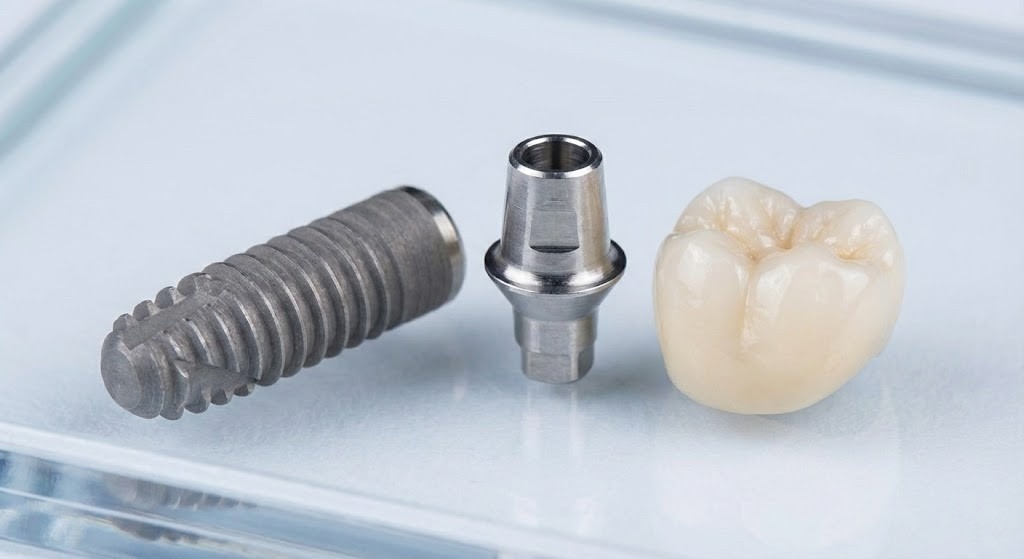
Many patients come in thinking an implant is one thing. It is actually three components that work together.
The Implant Post
This is the titanium screw that is placed into the jawbone during the surgical procedure. Titanium is used because it is biocompatible, meaning the body accepts it and the bone grows around and fuses with it over time. This fusion process is called osseointegration and it is what gives the implant its permanent stability.
The Abutment
Once the implant has integrated with the bone an abutment is attached to the top of the post. This is a small connector piece that sits just above the gumline and provides the base onto which the crown is secured.
The Crown
The crown is the visible part of the implant, the part that looks and functions like a tooth. It is custom made from ceramic to match the exact colour, shape, and size of your surrounding natural teeth. A well-made crown is completely indistinguishable from a natural tooth.
Understanding these three components helps patients understand why the process happens in stages and why each stage matters.
The Dental Implant Process at Dr. Dipti's Smile Suite: A Clear Timeline
One of the most common reasons patients delay getting a dental implant in Faridabad is that they do not know what the process involves. Here it is laid out clearly so there are no surprises.
Stage 1: Consultation and 3D Assessment
Your first appointment is a thorough evaluation. Dr. Dipti examines your teeth, gums, and bite, takes digital X-rays, and in most implant cases performs a 3D cone beam CT scan. This scan is the foundation of the entire treatment plan. It shows the exact bone volume, the position of nerves and sinuses, and the precise angle and depth at which the implant should be placed.
This is not a step that can be skipped or approximated. Accurate planning is what separates a predictable, successful implant from one that carries unnecessary risk.
Stage 2: Preparatory Treatment if Required
Not every patient needs preparation before implant placement but some do. Active gum disease needs to be treated and stable before surgery. Insufficient bone volume in the implant site may require bone grafting to rebuild the foundation. If a damaged tooth is still present it will need to be extracted, sometimes with a healing period before implant placement.
Dr. Dipti will be completely transparent with you about whether any of these steps apply to your case and what they mean for your overall timeline.
Stage 3: Implant Placement
The placement procedure is done under local anaesthesia. The area is completely numb before anything begins. A small incision is made in the gum, the implant post is placed into the prepared site in the jawbone, and the gum is closed around it.
Most patients describe the procedure as feeling significant pressure but not pain. The procedure takes between 45 minutes and 90 minutes for a single implant depending on the complexity of the case.
A temporary restoration may be provided the same day so you never leave with a visible gap.
Stage 4: The Healing Phase
This is the longest part of the process and it is almost entirely passive. Over the following 6 to 12 weeks the implant undergoes osseointegration, fusing with the surrounding jawbone. You continue your normal life during this period. The implant is healing invisibly beneath the gum.
There are no special requirements beyond following the aftercare instructions given by Dr. Dipti and attending your scheduled progress appointments.
Stage 5: Abutment Placement and Crown Fitting
Once osseointegration is confirmed through a follow-up scan the abutment is attached and impressions or digital scans are taken to design your custom crown. The crown is manufactured to match your surrounding teeth precisely and fitted at a final appointment.
Most patients describe this appointment as the most satisfying of the entire process. They leave with a complete, natural-looking, fully functional tooth.
Seven Things to Check Before You Choose a Dental Implant Clinic in Faridabad
Not all implant treatment is equal. The outcome depends significantly on where you have it done and who does it. Here is a practical checklist of what to look for.
The clinic should use 3D cone beam CT scanning for implant planning and not rely on standard 2D X-rays alone for surgical guidance.
The implant systems used should be internationally certified brands with documented long term success rates. Ask specifically which implant brand the clinic uses.
The dentist should have specific training and a significant volume of experience in implant placement. General dentistry training alone is not sufficient for complex implant cases.
The clinic should have visible, verifiable sterilisation protocols. Implant surgery requires a sterile surgical environment.
The treatment plan and cost breakdown should be provided in writing before treatment begins with no hidden additions afterward.
The clinic should offer clear aftercare instructions and accessible follow-up support throughout the healing process.
Patient reviews specifically mentioning implant treatment should be available and verifiable on Google or other independent platforms.
Dr. Dipti's Smile Suite meets every point on this checklist and we encourage every patient to ask these questions of any clinic they are considering.
Dental Implant in Faridabad: Addressing the Most Common Fears Directly
Fear 1: The Surgery Will Be Very Painful
The procedure is performed under local anaesthesia. The area is completely numb throughout. You feel pressure and movement, not pain. Post-procedure soreness in the first 2 to 3 days is mild and managed comfortably with prescribed medication. The vast majority of patients at Dr. Dipti's Smile Suite describe the experience as far more manageable than they had anticipated.
Fear 2: The Healing Will Take Too Long
The healing phase does take months but it is almost entirely passive. You are not in pain during this time, not restricted in your daily activities, and in most cases not visibly different to anyone around you because a temporary restoration covers the gap. The months pass quickly and the result is permanent.
Fear 3: It Might Not Work
Dental implants placed by an experienced implantologist using quality components and proper 3D planning have a success rate of over 95 percent. The most common factors in the small percentage of failures are smoking during the healing phase and uncontrolled medical conditions. Both of these are discussed openly during the consultation so the patient can make an informed decision.
Fear 4: It Will Look Obvious
A well-made ceramic crown matched to the colour and shape of your surrounding teeth is completely indistinguishable from a natural tooth in normal viewing conditions. Patients who are worried about this are consistently reassured once they see the final result.
After Your Implant: The Daily Habits That Protect Your Investment
Getting the implant placed and the crown fitted is the beginning of a long relationship with that tooth. How you care for it determines how long it lasts.
Brush twice daily with a soft-bristled toothbrush. Pay careful attention to the gum line around the implant crown where plaque accumulates most easily. Floss daily around the implant using regular floss or an interdental brush designed for implant care.
Avoid habits that put excessive force on the implant crown. Do not chew ice, bite nails, or use your teeth to open packaging. These habits can damage any tooth, natural or restored, over time.
If you grind your teeth at night, inform Dr. Dipti so a custom night guard can be made. Grinding puts significant repeated force on implant crowns and can shorten their lifespan considerably.
Attend professional cleaning appointments every six months. Professional cleaning removes calculus buildup around the implant that regular brushing cannot address and allows early identification of any changes in the surrounding gum or bone.
Do not smoke. If you smoked before the procedure, stopping during and after the healing phase significantly improves long term implant stability.
Why Patients Choose Dr. Dipti's Smile Suite for Dental Implant in Faridabad
Patients travel from across Faridabad, Delhi, Gurgaon, Noida, and the wider Delhi NCR region to Dr. Dipti's Smile Suite specifically for implant treatment. The reasons are consistent.
Dr. Dipti has over 15 years of experience in restorative dentistry with a strong focus on implant placement and full mouth rehabilitation. The clinic uses 3D cone beam CT scanning for every implant case. Internationally certified implant systems with proven long term success rates are used exclusively. Sterilisation protocols meet international hygiene standards.
But the reason patients consistently recommend the clinic to family and friends goes beyond the technology. It is the transparency. Patients receive honest information about their specific case, realistic expectations about the timeline and outcome, and clear costs before anything begins.
There are no exaggerated promises and no pressure to proceed before you are ready. The consultation is designed to give you the information you need, not to push you toward a decision.
Book your dental implant consultation today by calling or messaging us on WhatsApp at 8882850066. You can also visit us at SCF 142, Sector 14, Huda Market, Faridabad. We are open Monday to Saturday from 10am to 3pm and 5:30pm to 8pm.